Author: kward55

Why Read?

Good news, everyone! I am now fully retired, and I am back on my literary soap box. I know you have all been anxiously awaiting new postings (or at least some of you have, or possibly one or two of you). Here is a simple quote that I think epitomizes the value of reading. Simple but meaningful!

Quote by Matt Haig from Reasons to Stay Alive

Every time I read a great book I felt I was reading a kind of map, a treasure map, and the treasure I was being directed to was in actual fact myself. But each map was incomplete, and I would only locate the treasure if I read all the books, and so the process of finding my best self was an endless quest. And books themselves seemed to reflect this idea. Which is why the plot of every book ever can be boiled down to ‘someone is looking for something.

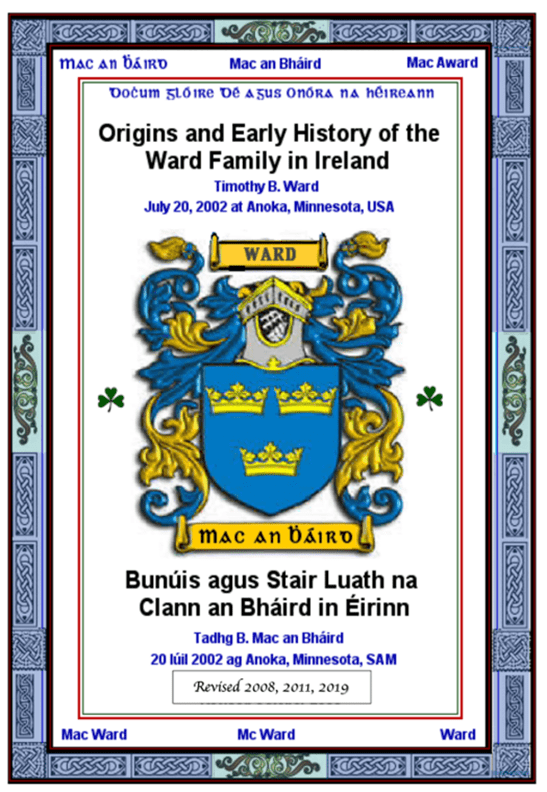
New Author: Tadhg B. Mac an Bhaird

Tadhg, a.k.a. Timothy B. Ward, has completed his much-anticipated manuscript about the Ward family in Ireland.

I am of Ireland,
Of the holy land of Ireland,
Good sir, pray I thee,
for in saintly charity,
Come dance with me in Ireland,
for Christ’s own sake.

– anonymous Irish minstrel

About the Author

Most people who know Tadgh B. Mac an Bhaird, a.k.a. Timothy B. Ward, are aware of his passion for both his family and his Irish heritage. However, even some of the people closest to him are not aware of his incredible writing skills. There is no question that Tadgh is the premier writer in this family!

To be sure, this is no typical story book. This is what I would call a scholarly piece of work that would earn the respect of any professional researcher. The amount of research, the uncovered facts, the intricate detail Tadgh has applied to this effort makes this an extraordinary piece of work. And he manages to tie it all together in an interesting, easy-to-read style!

Note from the Author

This book has evolved considerably over the twenty-odd years since I first produced a short version for our huge Ward Family reunion in Anoka in 2002. It is more than a labor of love – it is an effort to condense hundreds of years of history into a single overview and place our family’s history within a long-term context for the benefit of the generations coming after us. In that regard, I want to thank my brother Kevin for the idea of putting it on his blog. I also must thank our cousin, Shannon Ward Boie, for the extraordinary amount of research she has done on our family genealogy. She has single-handedly forged links with relatives in America and Ireland that would be lost without her efforts. The final revision was done in 2019, and that’s the version that appears here.

I leave the genealogy to Shannon’s able efforts. This book is not a genealogy but a history of our broader family origins extending back to a remote ancestor in the fourth century, a king of Ulster. We are familiar with Scottish clans, for example, that fusion of Irish settlers and Pictish tribes in the west of Scotland, but Irish family groupings are more usually referred to as “tribes” or “septs” – there were different rules in how they were formed, with the Irish structures being the older. The Irish were amongst the first people in Europe to develop a system of hereditary surnames. All the people of a chieftain’s territory would adopt the same surname, hence our family became the “Clann an Bháird” (pronounced “Clan-a-Ward”), meaning the family (or children) of the bard (or poet). Eoghan Mac an Bháird, the chieftain in the eleventh century who adopted “Mac an Bháird” as a permanent surname, was a professional poet although none of his poetry survives. All his sept would have adopted the same surname and intermarriage automatically integrated newcomers to the sept. Even the noblest and most well- documented families in Ireland would find it virtually impossible today to create a straight-line genealogy of their ancestors dating back more than several centuries. A quest by the earliest Irish historians in the sixth century to link their tribes’ descent to Adam and Eve, a normal practice in a Europe rapidly becoming Christianized, created muddling, confusion and inaccuracies, as mythological ancestors, saints, and even an apostle or two were placed within genealogies to enhance the prestige of different family groups. The brutal wars of the seventeenth century created chaos that resulted in mass destruction and unspeakable famines that severely blunted the existence of the Irish septs and their chieftains and decimated the population. It would be impossible to untangle them now. Nevertheless, and despite the odds, the family groupings formed by the native Irish from earlier Celtic practices did create a strong bond of identity within families and septs which has persisted and carried over unto today, in Ireland and amongst the families of the “Irish diaspora” around the world, like ours, that brought our part of the sept to America.

Ireland, being a small country and one with a prolific output of documentation after the time of Saint Patrick in the fifth century, has been able to retain a remarkable number of links with our ancestral septs and tribes. That is the point of this book, to condense all those references to the Ward’s (or Mac an Bháird’s, MacAward’s, McWard’s – there are hundreds) into a single work. We may very well be related by blood to some of the Ward’s mentioned within; we may even be related to most of them. However, it was the sept or tribal unit as a whole that dominated the thinking of Irish chieftains, and all the members of the Clann an Bháird sept were “kin” in accordance with ancient Celtic practices. As descendants of that family group, we are their kin, too, the kin of kings, warriors, poets and ecclesiastics of renown, referred to in the great seventeenth-century history of the Irish people, The Annals of the Four Masters, as “the learned family of Mac an Bháird”. This is covered at length within the Foreword and my Introduction in the book. Concurrent with our connection to our tribal unit in these pages you will also find connections to the cultural milieu from which we are descended. We often seem to have been a feisty bunch – sound familiar?

Go mbeannaí Dia daoibh go léir agus Éire go brách – May God bless you all, and Ireland forever!

Why Literature?

Sitting in my little writing enclave, I get inspired by all the different perspectives people have regarding literature, and reading in particular. The impact on individuals, and therefore the world, is profound! Here are some wonderful quotes to ponder.

Salvation is certainly among the reasons I read. Reading and writing have always pulled me out of the darkest experiences in my life. Stories have given me a place in which to lose myself. They have allowed me to remember. They have allowed me to forget. They have allowed me to imagine different endings and better possible worlds.
– Roxane Gay

Writing and reading decrease our sense of isolation. They deepen and widen and expand our sense of life: They feed the soul. When writers make us shake our heads with the exactness of their prose and their truths, and even make us laugh about ourselves or life, our buoyancy is restored. We are given a shot at dancing with, or at least clapping along with, the absurdity of life, instead of being squashed by it over and over again. It’s like singing on a boat during a terrible storm at sea. You can’t stop the raging storm, but singing can change the hearts and spirits of the people who are together on that ship.
– Anne Lamott

When our genes could not store all the information necessary for survival, we slowly invented them. But then the time came, perhaps ten thousand years ago, when we needed to know more than could conveniently be contained in brains. So we learned to stockpile enormous quantities of information outside our bodies. We are the only species on the planet, so far as we know, to have invented a communal memory stored neither in our genes nor in our brains. The warehouse of that memory is called the library. A book is made from a tree. One glance at it and you hear the voice of another person perhaps someone dead for thousands of years. Across the millennia, the author is speaking, clearly and silently, inside your head, directly to you. Writing is perhaps the greatest of human inventions, binding together people, citizens of distant epochs who never knew one another. Books break the shackles of time, proof that humans can work magic.
– Carl Sagan

The person, be it gentleman or lady, who has not pleasure in a good novel, must be intolerably stupid.
– Jane Austen

I Miss You Today

The book event of the year is finally here! Maureen Nelson is inviting everyone to her book launch and signing extravaganza that will be just in time for Christmas!

As you all know, Maureen has been working for several months on a children’s book about her grandson Riggins Larson. Little Riggins was born to Josh and Ashley on February 20, 2011. He had an extremely rare condition called congenital disorder of glycosylation type 1a (CDG-1a), for which there is no cure. Riggins was a constant joy to their family and all who had the good fortune to meet him, until his passing on November 15, 2019. The blessings Riggins brought to his family will be with them forever.

Maureen has now published a short book titled I Miss You Today, depicting some of her fondest memories of little Riggins. While it’s technically a children’s book, any adult will find her message moving and inspiring. In the book, each of her memories are associated with a photograph she took capturing that magical moment, and to add a dramatic touch, each of these pictures have been brought to life by the amazing illustrations of Heather Siegel, a former high school classmate of Riggins’ mother, Ashley. Heather has created stunning hand-drawn renditions of each of the pictures that will touch your heart like no standard photo can. Together, the words and illustrations are beyond moving, bringing forth a heartbreaking tear and a joyous smile with the turning of each page.

The signing event (hopefully the first of many) will take place on:

December 17, from 2:00 – 5:00 PM
Maple Inn
441 Second Street
Excelsior, MN
*Beverages and light snacks will be served

Come and join Maureen and her family for this wonderful event!

A New “Must Read” by Maureen Nelson

Another family member has taken up the pen!

Maureen (Ward) Nelson has put together an absolutely beautiful collection of thoughts and memories of her amazing grandson, Riggins. You may recall the article titled Behind the Chair, posted here on Literary Corner on February 20, 2021. It was written by Maureen’s son-in-law, Josh Larson, sharing thoughts about his wonderful son.

As many of you know, little Riggins was born to Josh and Ashley on February 20, 2011. He had an extremely rare condition called congenital disorder of glycosylation type 1a (CDG-1a), for which there is no cure. Riggins was a constant joy to their family and all who had the good fortune to meet him, until his passing on November 15, 2019. The blessings Riggins brought to his family will be with them forever.

Maureen has now published a short book titled I Miss You Today, depicting some of her fondest memories of little Riggins. While it’s technically a children’s book, any adult will find her message moving and inspiring. In the book, each of her memories are associated with a photograph she took capturing that magical moment, and to add a dramatic touch, each of these pictures have been brought to life by the amazing illustrations of Heather Siegel, a former high school classmate of Ashley’s. Heather has created stunning hand-drawn renditions of each of the pictures that will touch your heart like no standard photo can. Together, the words and illustrations are beyond moving, bringing forth a heartbreaking tear and a joyous smile with the turning of each page.

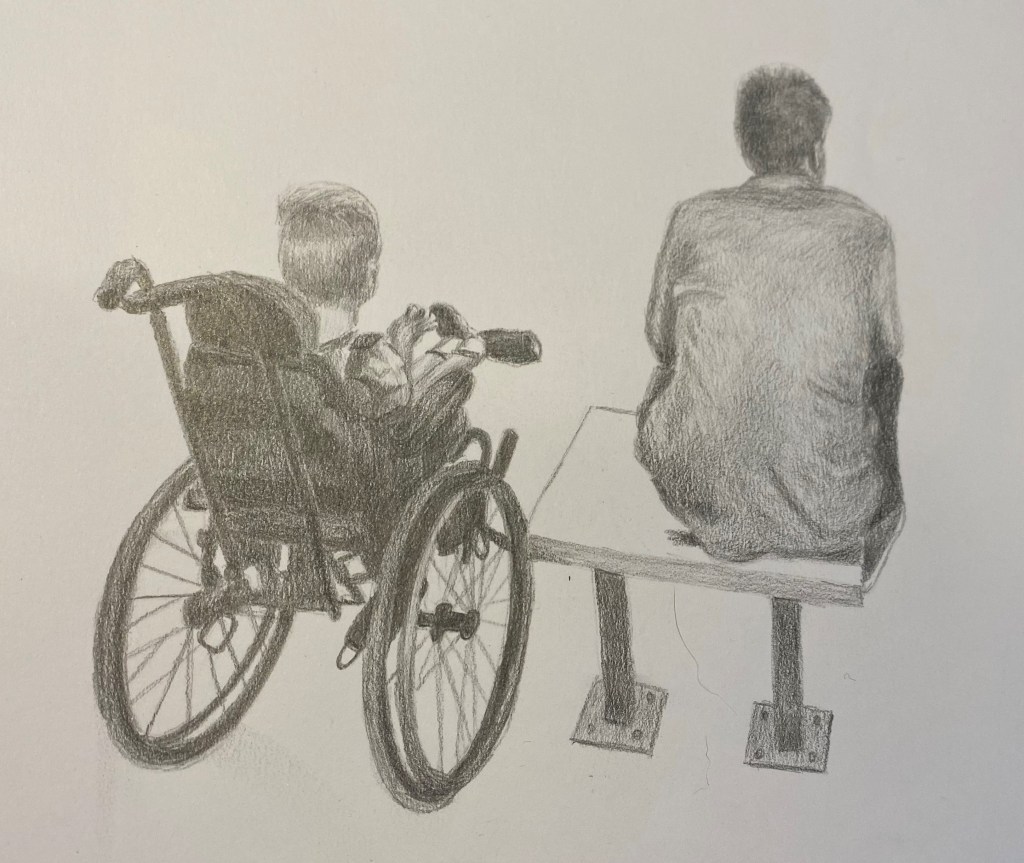
Here is just one example of an illustration by Heather created from a photo taken by Maureen:

Josh Larson sitting with son Riggins. This is just one simple yet powerful moment that Maureen has captured that will always stay close to her heart.

The book is in it’s final stages of production and will be released in late November. There will be a special book signing event shortly after release, currently planned for the first week of December.

Congratulations, Maureen. I can’t wait for the book signing!

The Library at Night

Once again brother Tadhg has treated us with an insightful view of the value of literature, this time through his review of The Library at Night, which is a fascinating work by Alberto Manguel of his thoughts on libraries and literature in general. Enjoy!

The Library at Night

Tadhg Mac an Bhaird

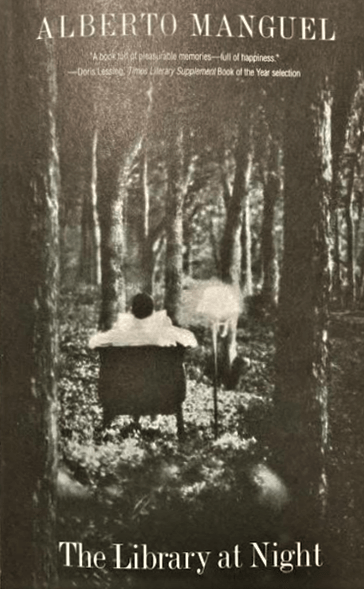
Yes, this is a person in the forest reading by the light of a soft lamp.

In the spirit of what Literary Corner is all about, I want to share my review of a book that was a wonderful gift from my lovely cousin, Kathy Bates Johnson of Ft. Worth, Texas. The Library at Night is more than just a fascinating book; for me it captures so much of what is magical about literature.

Anyone who’s ever found themself with a pile of books to read, who’s mused about “putting up a couple of shelves for these books,” who’s walked into a room, large or small, public or private, and been awed by the sudden expanse of glorious books in every direction, will love this book. The author, Alberto Manguel, seems to have read everything—no subject escapes his reader’s eye.

He frequently wanders into his home library at night. As the owner and creator of a humble little library of my own, I, too, find myself night after night, slipping into my library to savor the silent cacophony of books haphazardly packed into shelves in a room with too little space, where I can read, contemplate and mull over the next round of books I’ll add to my bulging collection. I’ll choose a history of the Druids, perhaps, or maybe an old Celtic history by Zimmer, or a Jon Hassler novel, the foundation author of our Minnesota Authors Book Club.

For others, you may bask in the soft glow of a Nicholas Sparks romance, or become enthralled in a John Grisham legal thriller, or possibly become inspired by a story of a sports hero. Regardless of your favorite genre, stories captivate all of us, and Manguel’s relationship with books and libraries often mirrors my vision of the same.

It is a profound book, a gem, glittering with musings and thoughts from librarians, readers and collectors spanning 3,000 years. I’ve given it its own place in the middle of my writing desk—the only book permanently stationed there—where, perhaps, a friend or relative may one day pick it up and read a page or two and suddenly exclaim, “I think I’m standing in the room this guy’s talking about.” The publisher of The Library at Night informs us that, “Inspired by the process of creating a library for his fifteenth-century home near the Loire, in France, Alberto Manguel, the acclaimed writer on books and reading, has taken up the subject of libraries. ‘Libraries,’ he says, ‘have always seemed to me pleasantly mad places, and for as long as I can remember I’ve been seduced by their labyrinthine logic.’

In this personal, deliberately unsystematic, and wide-ranging book, he offers a captivating meditation on the meaning of libraries. Manguel, a guide of irrepressible enthusiasm, conducts a unique library tour that extends from his childhood bookshelves to the ‘complete’ libraries of the Internet, from Ancient Egypt and Greece to the Arab world, from China and Rome to Google. He ponders the doomed library of Alexandria as well as the personal libraries of Charles Dickens, Jorge Luis Borges, and others. He recounts stories of people who have struggled against tyranny to preserve freedom of thought—the Polish librarian who smuggled books to safety as the Nazis began their destruction of Jewish libraries; the Afghani bookseller who kept his store open through decades of unrest. Oral ‘memory libraries’ kept alive by prisoners, libraries of banned books, the imaginary library of Count Dracula, the library of books never written—Manguel illuminates the mysteries of libraries as no other writer could.

With scores of wonderful images throughout, ‘The Library at Night’ is a fascinating voyage through Manguel’s mind, memory, and vast knowledge of books and civilizations.” Michael Dirda wrote in his editorial review in the Washington Post: “‘The Library at Night’―a series of essays on what one might call the Platonic idea of a library―reveals some of its author’s intellectual range and magpie learning … [It] is an elegant volume, in both its design and its text … Alberto Manguel has brought out a richly enjoyable book, absolutely enthralling for anyone who loves to read and an inspiration for anybody who has ever dreamed of building a library of his or her own.”

Bibles

Bibles are well known both for their spiritual value and the beautiful evolution of their various designs. I’ll leave your thoughts about the spiritual value up to you, but for people interested in the Bible as a literary work of art, here is an interesting article from brother Tadhg, featuring once again samples from the magnificent Mac an Bhaird Library.

Bibles

by Tadhg Mac an Bhaird

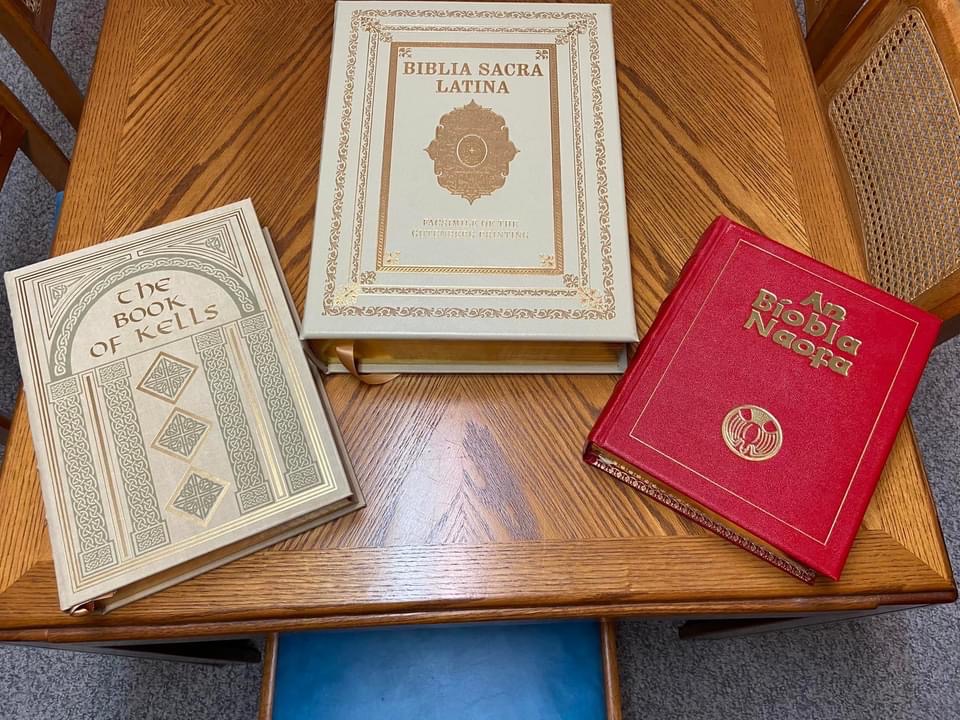
For those interested in Bibles as books, a little treat. The center book is a facsimile copy of a mid-15th century Gutenberg Bible – it is written in Latin in Blackletter typeface, sometimes called Gothic. On the left is a facsimile copy of the Book of Kells, a scribal manuscript of the four Gospels, written in the 8th century in Latin but using Irish script, and usually acclaimed to be “the most beautiful book in the world”. It is Ireland’s national treasure. On the right is An Bíobla Naofa – “The Holy Bible” – the only complete Bible ever published in the Irish language, in 1981. The lower photo shows samples of what is found within each. An Bíobla Naofa is opened to the Gospel of Mark. (The Mac an Bháird Library, Anoka, MN, USA)

Three Extraordinary Bibles
Content Samples

In The Woods

Hello everyone. For those of you in the Minnesota area, it’s nice to say that we’re finally getting a taste of spring! Frances Tallarico, who authored Snow Globe back in February, has treated us with another of her stories. Frances uses real-life experiences combined with a creative imagination to come up with her clever ideas. In today’s story, her walk through the woods was very real. Her inspiration was very real. The rest was the result of her creative interpretation. I hope you all enjoy it!

Frances also publishes a very interesting blog about her travels and experiences, and for anyone interested, here is the link: https://lifeculture.travel.blog. Check it out!

In The Woods

By Frances Tallarico

Hiking among the magnificent redwoods fills me with awe. The narrow trail winds up along the Smith River, rising from gently sloping to steep, with steps cut into the soil in some places to facilitate the climb. I’m surprised to see rhododendrons in bloom along the path, as well as wild Douglas iris, and a variety of other flowering plants and berries. The new-grown tips of the redwood trees are soft and feathery. A wall of ferns feels silky.

It’s hot, but there’s a refreshing breeze. I don’t know how long I’ve walked, and I’m thirsty. I see a tree stump and decide to sit, rest, and drink some water. I’m deep enough into the woods that I hear only the sound the wind makes as it whispers to the trees, and birds singing. Their songs are different from ones I’m used to hearing. I sing a song of made-up words about how beautiful the trees and sky are, and how happy I feel to be here.

“That’s nice.” I hear someone say. I’m startled. I thought I was alone. “More please.”

I look around and realize that what I thought was a tree, was actually an extraordinarily tall person, covered with shaggy hair. 

“I don’t normally talk to humans, but I don’t think you’d hurt me, and you’re happy.” His voice was soft, calm. “Everyday, I come to look at the river. I can stand in the trees and people don’t see me, although they look for me.” I noticed that he did blend in with the trees. It was his stillness. “Be careful. You’re vulnerable alone in the woods,” he said.

“From wild animals?”

“No, other humans.”

“Most people are nice.” I say, and then realize that as I’d be afraid of a bear, he was afraid of humans. “Has a human ever hurt you?”

“No, but I see what they do to other creatures and to each other.”

I sit quietly beside him, enjoying his presence, letting time pass.

“What you’re looking for, I think you’ve found it.” He sighed.

The wind sighed.

I sighed.

Afraid of the Dark

It appears there is interest in broadening out Literary Corner just a bit. Rather than just having people’s thoughts about literature in general (which I still want to do, and I invite anyone to submit an article), I think it is also nice to include actual writings; short stories, poems, haikus, and things like that. The most recent submission, Snow Globe, submitted by Frances Tallarico, was the first of these writings. Today I have a very intriguing children’s story written by my son-in-law Arthur Reynolds. He and his wife Megan (my daughter) have done some children’s writing before, and now with their own daughter getting close to the reading age, Arthur is beginning to pursue his interest with a new level of energy.

The following, Afraid of the Dark, is a clever story even adults will find interesting.

Afraid of the Dark

by Arthur Reynolds

The streetlights lined the lane like a trail of breadcrumbs leading Daniel home. The warm saucers of light were safe from the moonless night around them. Daniel leapt from light to light to avoid the things hiding in the darkness. If only he’d left his friend’s house an hour sooner perhaps he could have beaten the sun home.

Daniel had always been afraid of the dark. His parents had said that “Nine years old is too old for a night light”, but Daniel knew better. You couldn’t know what was out there waiting for you to step into its reach. It was much safer to have a light to depend on. 

He could feel his heart skip a beat each time he passed through the darkness between the streetlights. This was hardly the worst of it though, there was only one lamp post on the street where he lived and it was on the wrong side of the road. Once he got to the end of the lane he’d have to sprint down his street with no lights to guide him.

With only two lamp posts to go, he landed in the circle of light and looked back to see how far he’d come. All of the streetlights behind him had gone out. The hair on the back of his neck stood straight up. Something has been gobbling up the light behind him as he ran. He turned to run home but the lights ahead of him had been eaten as well. He stood in the last remaining light on the block with darkness surrounding him. His body would not move as a bite was taken out of the edge of the light’s perimeter. It made no sense. The light was being eaten as if it were a large custard pie. Bite by bite the light grew smaller until all that remained was the spot beneath him that was being covered by his shadow. 

“Excuse me. Would you mind taking a step to your left please?” said a voice from the darkness. It was high-pitched and friendly. The type of voice you’d expect to hear from a cartoon sheep. Daniel jumped back in surprise.

“Thank you.” The thing said as it gobbled up the last bits of light. With all of the light gone now Daniel’s eyes adjusted to see what was talking to him. It was a small black furry thing the size of a big cat or a small raccoon. Its yellow eyes looked up at Daniel. They shone like little moons. 

“Do you know where I can find more?” the thing asked. Daniel hesitated for a moment. It didn’t seem scary or mean. In fact, its furry face was kind of cute. Two glowing eyes lit up the rest of its face to reveal a drooping snout that fell over its toothless mouth. It was kind of like an anteater mixed with a hairy black pillow. 

“Excuse me, sir. Do you know where I can find more?” it repeated. 

“More light?”

“Yes. I’ve got to reach my quota.” 

Daniel thought this was very strange. Rightfully so. Who had ever heard of a light quota? Daniel had known that his parents paid for electricity because they often complained about the bills when they came. As long as it wasn’t him the thing was after Daniel had no reason to be afraid of it. 

“There is another post around the corner. Just up ahead,” he said. 

“Thank you kindly.” said the thing and it turned and walked off into the night towards Daniel’s street. Caught with curiosity, Daniel followed it. 

The thing sniffed at the ground with its snout as it walked down the street. It appeared to catch a smell that it liked because it began to pick up speed. Daniel found himself hurrying after it. It seemed to be heading straight for the lamp post.

“What does light smell like?” Daniel said thinking out loud. 

“It smells tart and sweet. It tastes good too!” the thing said happily.

Daniel thought of the lemon meringue pies that his father made for holidays and his mouth began with water. He was quite hungry and ought to be getting home. It was after nine now. His parents always went to bed early for work and he would usually be in bed by now also. He was sure his dinner was in the fridge waiting for him. Daniel watched hungrily as the thing ate the light from the lone lamp on his street. 

“More?” the thing asked. 

“Why do you need to eat so much light?”

“We need to bring it back with us. It’s used to power our home.”

“Well, the only other lights that I know of are the lights in my house,” Daniel said.

“Great! Let’s go there!” it said as it hopped down from the curb towards him. Daniel thought that his parents wouldn’t mind the lights being eaten in their home since they always complained about how the lights were always on. 

“What happens to the lights once you eat them?” Daniel asked. 

“The big lights always come back eventually, but smaller lights usually need to be replaced.”

Daniel led the thing to his house and made it wait outside so that he could make sure his parents were asleep before letting it in. It happily ate the light cast out the windows while it waited. Daniel’s father had already gone to bed and his mother was sitting up to wait for him. 

“You’re home late”, she said. 

“Yeah, we got caught up playing games. I’m sorry.”

“I’m just glad you made it home okay. I was expecting a call once it got dark out. It’s darker than usual tonight.” She warmed up his dinner and once he’d eaten, she brought him to bed. It was not unusual for Daniel to sit up a bit in his room, so his mother thought nothing of it when he wanted to keep his light on to read.

Once he was certain that his parents were both asleep he crept downstairs and let the thing in. 

“Thank goodness!” It said, “I was starting to think you’d leave me out here”. Daniel led the thing around the house from room to room as it gobbled up the lights. The house grew dark as they made their way upstairs to Daniel’s room.

“I need just a little more.” the thing said as it finished eating the light from his lamp and ceiling fan. Daniel had been afraid of that. The only light left was his night light. 

“I need the night light, I’m sorry. I’m just too afraid of the dark.” Daniel said. The thought of going without his nightlight made him scared for the first time since he met the little fuzzy thing. 

“How can you be afraid of the dark?!” the thing said surprised. “We’ve been in the dark all night.” Daniel realized that his new fuzzy friend was right. They had been walking around without light this whole time, and nothing bad had happened. If a fuzzy little thing could be happy in the darkness, then maybe he could too. 

“Okay,” Daniel said. “You can take it.”

“Thank you! Thank you!” It quickly gobbled up the glow from the nightlight and Daniel’s room fell dark. All he could see was the eyes of his friend glowing the brightest they’d glowed all night. It looked happy and full. 

“Could you open the window, please? I must be on my way.” The thing asked. Daniel followed it to the window and opened it up. The thing hopped into the air and didn’t come down. It floated out the window like a balloon. 

“Goodbye.” The thing said. “Thank you for all of your help!”

Daniel waved goodbye to the thing as he watched it float up into the night sky. Its eyes glowing like a pair of fireflies dancing through the night. Daniel saw more and more lights float up to join it. There were hundreds of glowing little things in the sky. They floated upward and came closer together until they made a large circle among the stars. The moon shone brightly, lighting up Daniel’s street and casting light into his room. Daniel was no longer afraid of the dark.