I have spoken to many of you about submitting articles for Literary Corner. While most people seem to enjoy the articles, not so many people are quite ready to submit one. I’d like to remind everyone that the charm of Literary Corner is that the input comes from a variety a people with unique ideas and unique skill sets, so everyone is capable of creating something people will find value in. So, if any of you are willing and ready to submit an article, please let me know. Or if you know anyone who would enjoy doing this who is not currently following this site, invite them to contact me. If I don’t get something soon, I’m going to have to dig into the Philosophical Files of Kevin J. Ward again. Just a heads-up warning.
Category: Literary Corner
In the true spirit of Literary Corner, Keevan Kosidowski (don’t let the name fool you – she’s Irish) gives us a wonderful sense of the value of literature to her throughout her life. I believe this illustrates not only the joy one can experience from literature, but the learnings and insights a person can develop along the way. Thank you Keevan for this excellent piece.
What Does Literature Mean to Me?
by Keevan Kosidowski
What does literature mean to me? As I was contemplating this question, I came up with a number of thoughts with one common theme: connection. Many years ago, I took the Strengths Finder survey where Connectedness was identified as one of my top five strengths. According to Tom Rath, author of Strengths Finder 2.0, connectedness implies “we are part of something larger…we are not isolated from one another or from the earth and the life on it.” In my life, literature is connection…connection to my past, to my family, to the world around me and even a connection to myself.
Growing up in Cedar Falls, Iowa, a town of about 30,000, was rich in its simplicity. Many of the habits I formed as a child and young adult are still with me today (for better and for worse!). I was reading all of the time and so were the important people in my life – my mom, her sister and my step-dad. Summertime in Cedar Falls centered around Ray Edwards, the local swimming pool, and the library. My siblings and I rode our bikes 1.5 miles to the library at least once a week to stay current with the summer reading program. One summer, we were pictured on the front page of the local paper reading our books as we lounged on a large stuffed animal. I can still see that picture in my mind’s eye. Thinking back, two books stand out in my memory from those early years: A Summer to Die by Lois Lowry and Where the Red Fern Grows by Wilson Rawls. I read both of those books multiple times even though I was so torn up by the death of Molly in A Summer to Die and Billy’s dogs in Where the Red Fern Grows. Maybe this was an outlet for my own emotions… a connection to my own sadness that I buried deep inside of not only riding my bike to the library, but also between two homes.
Over time, my love for the Cedar Falls Public Library was transferred to the Cedar Falls High School library, where I discovered Danielle Steel and Stephen King and spent breaks between classes sitting in the library’s small sitting area reading. It was in high school where I was exposed to more serious literature by Mrs. Vance, my Great Books teacher. She introduced me to F. Scott Fitzgerald, Ernest Hemingway, and Machiavelli to name a few. This laid the foundation for an interest in the classics that blossomed after graduating college and moving to Seattle. My first apartment was a studio on lower Queen Anne, right by the Space Needle, and across the street was a used bookstore. During this time, my aunt introduced me to Barbara Kingsolver and her great storytelling through eclectic modern day novels of which The Poisonwood Bible is one of my favorites. As I reflect on my young adult life, I can see myself, book in hand, frequenting coffee shops and restaurants throughout Seattle. Similar to the power music has to take us back to an experience, literature keeps me connected to these precious people and experiences.
The love of literature is also a connecting point with my kids. For years, we have closed each day over a good book while cuddling on the couch and speculating about the next twist of the story. My son and I devoured the Chronicles of Narnia series, Jack London’s Call of the Wild and White Fang, the Adventures of Huckleberry Finn and Tom Sawyer along with historical fiction like Johnny Tremain. This ritual continues today with my nine-year-old daughter. Last year, we delighted in Laura Ingalls Wilder’s Little House on the Prairie series, which inspired a family road trip to western Minnesota and South Dakota this past fall. The books gave new meaning to the stark South Dakota landscape. The expansive, uninterrupted, flat prairie became the path Laura and her sisters walked to school from their claim shanty. The small town, which felt lifeless to us during our visit, was once the lively place where young people gathered and where the family sheltered during The Long Winter. We often compare the pioneering life with our modern lives and marvel at the ease modern inventions have brought to our lives. At the same time, there is a longing in our hearts for the sense of community, neighborly connection and interdependence the pioneers shared and needed for their very survival.
I’m also grateful for the connection literature has brought to my relationships with my adult kids. Over the past few years, one of our daughters has developed a love for reading. She introduced me to the Goodreads app, where she shares her latest finds in contemporary selections. One Sunday this past fall, she rushed into our house flush with excitement to tell us about the book she had just finished – Transcendent Kingdom by Yaa Gyasi. She passed her copy to me and shortly thereafter, I read it in a weekend. My new daughter-in-law and I also connect through literature. We love non-fiction books that help explain and contextualize the work of science and medicine. From The Immortal Life of Henrietta Lacks to The Hot Zone, these books are thrilling and shocking and read like a work of fiction. I treasure the way literature has brought depth and strength to these relationships.
Each day is a new opportunity for me to refresh through literature. Reading is my favorite past time. Diving into a wonderful piece of literature is my way to relax, learn and entertain myself. Even more important, literature connects me to my faith. I start each day in the Bible and with a daily devotion. I complement that with books that explain and reflect upon scripture. Through books of historical fiction like, The Galileans: A Novel of Mary Magdalene by Frank Slaughter, I learn about the context of these ancient times, people and events.
In writing this piece, I realize how important literature has been to building connections in my life….connections to people and to experiences. Putting this on paper has been a sweet exercise. I’m betting you will come away with a bit of new thinking about the impact of literature in your own life and maybe even find some new titles to check out too.
Today I am going to deviate slightly from the theme of Literary Corner to bring you a powerful and moving piece from Josh Larson. Little Riggins was born to Josh and Ashley on February 20, 2011. He had an extremely rare condition called congenital disorder of glycosylation type 1a (CDG-1a). Riggins was taken back to heaven on November 15, 2019. He would have been ten years old today. Josh’s piece illustrates so clearly the blessing Riggins was to their whole family.
Behind the Chair
by Josh Larson
February 20, 2015
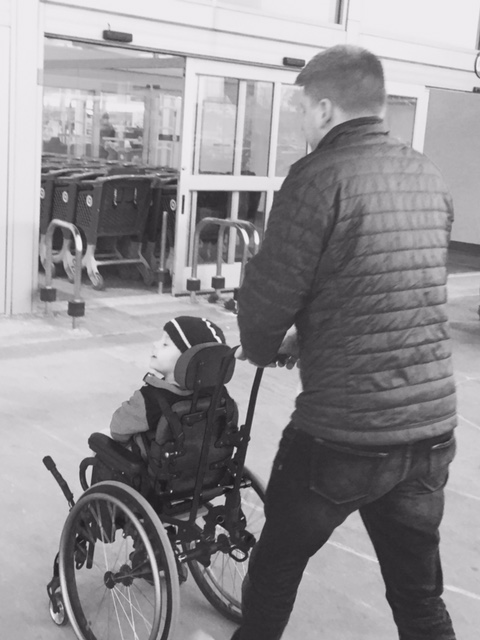
As I walk through the door pushing my son in front of me I feel proud. I am proud that I have the opportunity to be the one standing behind this chair, and that I am the one who gets to call this boy in front of me my own.
From the moment I start to lift my son out of the car and into his chair for a routine errand to the grocery store his face lights up. His excitement level will grow after we buckle him in and start rolling towards the door. His eyes will widen and his legs will bounce with energy and shoot straight out in front of his chair. He will start looking all around with a big grin on his face and cock his head backwards and upwards to look up from his chair and smile right at me. He doesn’t use any words to communicate, but in this moment he doesn’t need to. I know what he is saying. He isn’t saying I love this store or I am excited to get a new toy or treat. He is saying I love you, and I love being with you and I am excited to go wherever you take me. As we proceed through the store going about our errands, many people that we pass will take notice of him and offer a quick smile towards him and then up to me, and I will reciprocate. Of course there also will be others that will look with a smile followed by a sad or pity-filled expression. There might even be those that I will hear behind our backs saying something like, “Ohhhh, did you see that boy? That’s so sad.”
I might not say anything, but what I think about in those moments is that they must not have looked at the expression on his face. They only saw the chair and not the smile of a little boy who is filled with Joy and the proud father guiding him whom gets to call him his own.
I can’t help think of the parallel of how our heavenly father feels about each and every one of us. Despite all our imperfections, he is standing right there with us with that same sense of pride knowing that he was our designer and he formed whom we are with an intentional design. He does not look at us with pity when seeing our imperfections because he already knows each of us are imperfect. Just like me standing behind that chair, his satisfaction and delight in us does not come through our impressive accomplishments. He is fulfilled in a similar way that I am with a simple act of acknowledging him, and “saying” I love you and I love having you in my life and I will follow you wherever you take me.
2-20-15
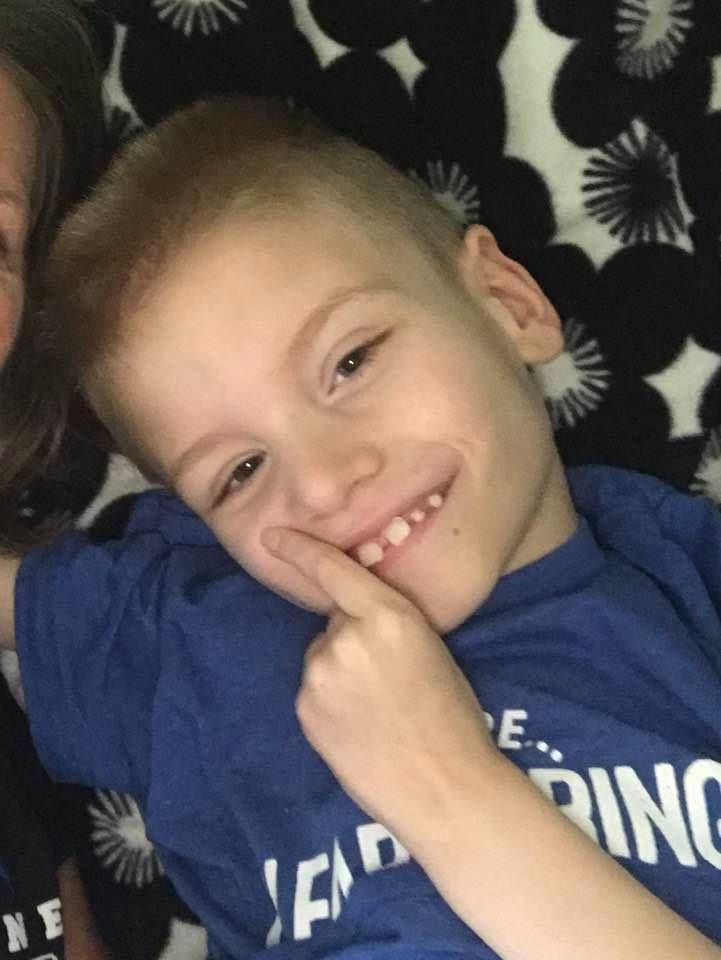
Little Riggins
by Phillip W. Ward
February 4, 2021
I am not a writer in the way you may imagine if you are reading this. It is my intent to make that clear from the start. However, like all people, I have thoughts, feelings, emotions, and opinions on a wide variety of topics. More importantly, I have a desire to communicate those various sentiments in the most effective way I can. Whereas I enjoy a good face to face discussion, which on occasion can boil over into an argument, I have found that many times, at the moment I am feeling whatever I’m feeling, there simply isn’t anyone around to talk too. When that occurs, I turn to writing in order to clear my head, say my piece, clarify my thoughts, and ultimately, find peace with the issue at hand. So in that way, I am a writer. Furthering that thought, I have also learned to take a personal experience, write it down, come to grips with it, and somehow transform that experience into a written story. Nevertheless, I have found that creating a written story is no guarantee that it will be interesting to those of you who choose to read it. For me, it is a difficult struggle to put on paper, thoughts that would easily flow from my mouth.
To be completely honest, journaling is a more accurate depiction of what I do. For many years, I have used this technique to clarify thoughts, ease tensions, and on a positive note, document memories of enjoyable times, people, and events that have assisted me in creating the fabric of my life. Yes, I have always looked upon myself as a verbally gifted storyteller. I can spin a yarn, or make you laugh, and on occasion, bring a tear to your eye through the process of using my voice to communicate a message in that moment. I am and always have been very comfortable in conversation. In fact, it is this comfort level that led me to believe that I could accomplish the same goals if I chose to use the written word. To be blunt, I thought it would be easy. However, the skill of writing has proven to be a significant challenge for me, as I suspect it may be for many of you reading this blog.
It is not my intention to discourage you at this point, although my words my seem discouraging as they are read. Though writing is an extremely difficult task to perform well, it is also an extremely joyful experience, even if it is done poorly. I can say this because I seldom write anything that is publishable, but I almost never write something that doesn’t affect me in a positive way. The joy of writing is ensconced in a person’s desire to create a literal version of their thoughts and feelings. The joy I feel from having written a story or a book is difficult to come by in any other medium. Plus, the only way I know how to improve at the skill is to actually write. While most of what I write is not a great read for anyone but me, I can assure you that I am totally fine with that outcome. I write mainly for myself, and if I decide to try and share whatever I have written with others, the only real issue is that I approve of the finished product. It is with that in mind that I feel comfortable presenting you with some non-professional advice. If it helps, great! If not, so be it. It is simply my opinions on how a person begins to develop into a writer.
The first piece of advice is that you make your writing personal. You may have a gifted imagination, but life experiences, even if you change the names, dates and places, will ring much more authentic than trying to create a scenario with which you have no prior knowledge. This is not to say you can’t embellish your story. But it is critical in my estimation to have at least some idea of how it feels to have been in the situation you are describing. This will serve to enhance the tale that you are sharing with your readers.
Second, you must understand that writing well is hard work. As you prepare a piece for publication, you will rewrite it so many times that you’ll feel as though you have it memorized. Experience has shown me that no matter how well I may have written something, upon review, I can find a better way to write it. It is an endless loop requiring you at some point to simply acknowledge that what you have written is good enough. Then move on.
Third, demonstrate courage when you write. There are critics everywhere, and not just in the field of writing, as you are already aware. Toughen up, write something that interests you, that makes a point you want to make, and/or teaches a lesson you feel strongly needs to be taught. If you want to write, then you can not be afraid to fail, to be criticized, or to be laughed at. You will never accomplish anything if you approach your goals from a perspective of fear. This is especially true in the process of learning to write. I can assure you that I have written some horrendous words, and when I’ve re-read them, I was appalled at my work. Chalk it up to experience and get better.
Finally, be kind to yourself as you create your work. No one writes a masterpiece their first time out. All writers have hundreds of re-writes with every piece they produce. This is why it is hard work. But on occasion, when you read something you have produced that makes you feel proud, make sure you enjoy the moment. For it is in that moment that you realize that even if no one else appreciates what you have done, you’ll know in your heart that you have accomplished a worthwhile task. I love that feeling, and I encourage you to strive to find it for yourself.
I hope you write a lot, and I hope you enjoy it. It is a unique joy for me to work hard at this endeavor in which I am clearly not gifted. But in a real sense, the joy of writing is embedded in the work. It is why I continue to write, and why it is my belief, I’ll continue this for a lifetime. Good luck to you in your work, and don’t give up!
 Kevin J Ward