Category: Uncategorized

New Author: Tadhg B. Mac an Bhaird

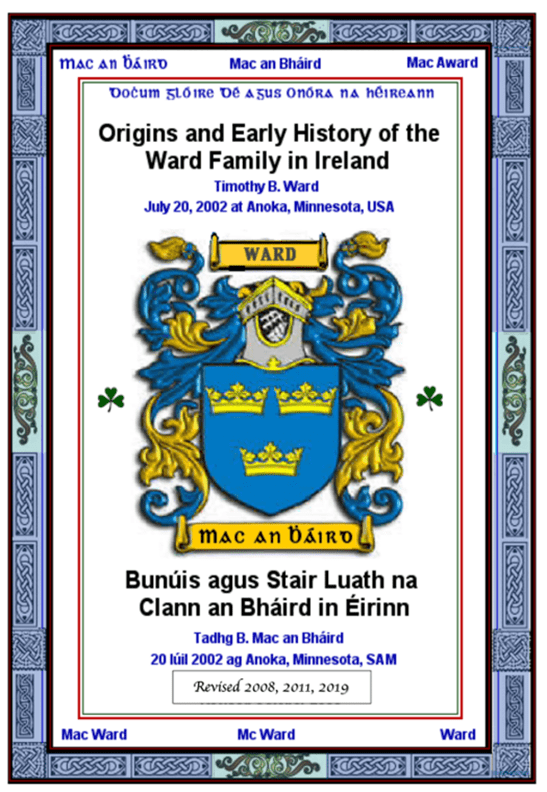
Tadhg, a.k.a. Timothy B. Ward, has completed his much-anticipated manuscript about the Ward family in Ireland.

I am of Ireland,
Of the holy land of Ireland,
Good sir, pray I thee,
for in saintly charity,
Come dance with me in Ireland,
for Christ’s own sake.

– anonymous Irish minstrel

About the Author

Most people who know Tadgh B. Mac an Bhaird, a.k.a. Timothy B. Ward, are aware of his passion for both his family and his Irish heritage. However, even some of the people closest to him are not aware of his incredible writing skills. There is no question that Tadgh is the premier writer in this family!

To be sure, this is no typical story book. This is what I would call a scholarly piece of work that would earn the respect of any professional researcher. The amount of research, the uncovered facts, the intricate detail Tadgh has applied to this effort makes this an extraordinary piece of work. And he manages to tie it all together in an interesting, easy-to-read style!

Note from the Author

This book has evolved considerably over the twenty-odd years since I first produced a short version for our huge Ward Family reunion in Anoka in 2002. It is more than a labor of love – it is an effort to condense hundreds of years of history into a single overview and place our family’s history within a long-term context for the benefit of the generations coming after us. In that regard, I want to thank my brother Kevin for the idea of putting it on his blog. I also must thank our cousin, Shannon Ward Boie, for the extraordinary amount of research she has done on our family genealogy. She has single-handedly forged links with relatives in America and Ireland that would be lost without her efforts. The final revision was done in 2019, and that’s the version that appears here.

I leave the genealogy to Shannon’s able efforts. This book is not a genealogy but a history of our broader family origins extending back to a remote ancestor in the fourth century, a king of Ulster. We are familiar with Scottish clans, for example, that fusion of Irish settlers and Pictish tribes in the west of Scotland, but Irish family groupings are more usually referred to as “tribes” or “septs” – there were different rules in how they were formed, with the Irish structures being the older. The Irish were amongst the first people in Europe to develop a system of hereditary surnames. All the people of a chieftain’s territory would adopt the same surname, hence our family became the “Clann an Bháird” (pronounced “Clan-a-Ward”), meaning the family (or children) of the bard (or poet). Eoghan Mac an Bháird, the chieftain in the eleventh century who adopted “Mac an Bháird” as a permanent surname, was a professional poet although none of his poetry survives. All his sept would have adopted the same surname and intermarriage automatically integrated newcomers to the sept. Even the noblest and most well- documented families in Ireland would find it virtually impossible today to create a straight-line genealogy of their ancestors dating back more than several centuries. A quest by the earliest Irish historians in the sixth century to link their tribes’ descent to Adam and Eve, a normal practice in a Europe rapidly becoming Christianized, created muddling, confusion and inaccuracies, as mythological ancestors, saints, and even an apostle or two were placed within genealogies to enhance the prestige of different family groups. The brutal wars of the seventeenth century created chaos that resulted in mass destruction and unspeakable famines that severely blunted the existence of the Irish septs and their chieftains and decimated the population. It would be impossible to untangle them now. Nevertheless, and despite the odds, the family groupings formed by the native Irish from earlier Celtic practices did create a strong bond of identity within families and septs which has persisted and carried over unto today, in Ireland and amongst the families of the “Irish diaspora” around the world, like ours, that brought our part of the sept to America.

Ireland, being a small country and one with a prolific output of documentation after the time of Saint Patrick in the fifth century, has been able to retain a remarkable number of links with our ancestral septs and tribes. That is the point of this book, to condense all those references to the Ward’s (or Mac an Bháird’s, MacAward’s, McWard’s – there are hundreds) into a single work. We may very well be related by blood to some of the Ward’s mentioned within; we may even be related to most of them. However, it was the sept or tribal unit as a whole that dominated the thinking of Irish chieftains, and all the members of the Clann an Bháird sept were “kin” in accordance with ancient Celtic practices. As descendants of that family group, we are their kin, too, the kin of kings, warriors, poets and ecclesiastics of renown, referred to in the great seventeenth-century history of the Irish people, The Annals of the Four Masters, as “the learned family of Mac an Bháird”. This is covered at length within the Foreword and my Introduction in the book. Concurrent with our connection to our tribal unit in these pages you will also find connections to the cultural milieu from which we are descended. We often seem to have been a feisty bunch – sound familiar?

Go mbeannaí Dia daoibh go léir agus Éire go brách – May God bless you all, and Ireland forever!

End of Summer Book Sale!

Summer’s almost over. As you get ready for the coming fall, enjoy 25% off The Seduction of Paradise and The Longest Walk. Go to the Mystery and Suspense page or the Romance page and check out the discounts for these two exciting novels. Maybe even time to start thinking about Christmas presents!

Sale period lasts until September 15. Discounts are only available directly from this website.

Why is Literature Important?

I came across this article on penlightener.com the other day. I feel it captures what I view as the value of literature to the human society, not just for today but throughout history. I thought some of you literature fanatics out there might appreciate this.

Why is Literature Important?

“Literature adds to reality, it does not simply describe it. It enriches the necessary competencies that daily life requires and provides; and in this respect, it irrigates the deserts that our lives have already become.” ~ C.S. Lewis, a British scholar and novelist

This adage is perhaps the most appropriate description of the importance of literature in our lives. Literature reminds us of stories, epics, sacred scriptures, and classical works of the old and modern times. It is defined as the body of written works of a language, period or culture, produced by scholars and researchers, specialized in a given field. Why is literature important? Let us see.

Literature Adds Value
As stated in the quote by C.S. Lewis, literature not only describes reality but also adds to it. Literary works are portrayals of the thinking patterns and social norms prevalent in society. They are a depiction of the different facets of common man’s life. Classical literary works serve as a food for thought and encourage imagination and creativity. Exposing oneself to good literary works, is equivalent to providing one with the finest of educational opportunities. On the other hand, the lack of exposure to good literature is equal to depriving oneself from the opportunity to grow.

Parts of Literature
Prose, poetry, drama, essays, fiction, literary works based on philosophy, art, history, religion, and culture as also scientific and legal writings are grouped under literature. Creative nonfiction of the olden times and literary journalism also fall under literature. Certain extremely technical writings such as those on logistics and mathematics are also considered as a part of literature.

Literature Impacts Living
Some of the great literary works like the Bible and Indian epics like Ramayana and Mahabharata, among others, provide society with the guiding principles of life. Works by poets like Homer, Plato, Sappho, Horace and Virgil, Shakespeare’s sonnets and notable poetry by W.B. Yeats, John Keats, Wordsworth, Tennyson, and William Blake, among others, are timeless. They have always amused their readers and shall continue to. The Lord of the Rings, The Godfather, A Tale of Two Cities, and James Bond Series are some of the best-selling books of all time that have entertained several generations. While some literary and poetry works carry life’s lessons, many others make us think. Some works are known for the sheer entertainment they provide, while others intrigue. Many works in literature establish a strong connect with their audience through the stories they narrate or the message the carry. Readers tend to associate themselves with the emotions portrayed in these works and become emotionally involved in them. Literature thus has a deep impact on the readers’ minds and in turn, their lives.

Children’s Literature
The Adventures of Pinocchio, Alice’s Adventures in Wonderland, and Winnie-the-Pooh, as also the relatively recent Harry Potter Series are some of the greatest works in children’s literature. Due to a whole new world they create through words, or due to their characters that the readers can relate to, these books attract children. Amused by the stories they tell, kids associate themselves with these books’ characters and idealize some of them. Moral stories are an aid for parents and teachers to let the kids learn important lessons in life. Aesop, Enid Blyton, Roald Dahl, and Mark Twain, among many others are some of the most widely popular children’s authors. They have enriched the childhoods of so many. Their works have amused millions of children the world over.

Literature Helps Understand Life
It is through reading great literary and poetic works, that one understands life. They help a person take a closer look at the different facets of living. In many ways, literature, in its different forms, can change one’s perspective towards living. Biographies of great people, real-life stories of courage, sacrifice and other good values never fail to inspire readers. Such works give the masses an insight into the lives of eminent people, and also serve as a bible of ideals.

It Provides Information
Literature serves as an enormous information base. Research works by famous inventors and literary works by notable scientists often narrate stories of their groundbreaking discoveries and inferences. Ongoing developments in the fields of science and technology are documented so that the world can know about them. Several ancient scriptures relating stories of human evolution and narratives of human life in those times, have been of tremendous help to mankind. Thus, literature has always served as an authentic source of information.

Scope of Literature
True, languages are the building blocks of literature. But the study of literature cannot be restricted to only studying languages. In fact, literature cannot be confined to an educational curriculum. A degree in language and literature is perhaps not able to provide one with everything that literature can offer. Its scope is so deep and wide that even a lifetime may not be enough to really ‘study’ literature.

Literature is Important
For the breadth of knowledge is gives, the moral values it carries, and the enjoyment it provides, literature is important. An exposure to good literary works is essential at every phase of life as it enriches us in more ways than one. Literature is definitely much more than its literary meaning, which defines it as ‘an acquaintance to letters’. In fact, it lays the foundation of a fulfilling life. It adds ‘life’ to ‘living’.

Post Script
As a post script to this article, I would like to add that an equally rewarding and beneficial aspect of literature is in creating it. Whether one has the talents of Shakespeare or Yeats, or simply the urge to express thoughts and ideas to share with others, creating literature (writing) provides its own sense of learning and understanding. Often times when one composes a piece of literature to be shared with others, the author learns more about the subject than the recipients do. Plus it’s a lot of fun!